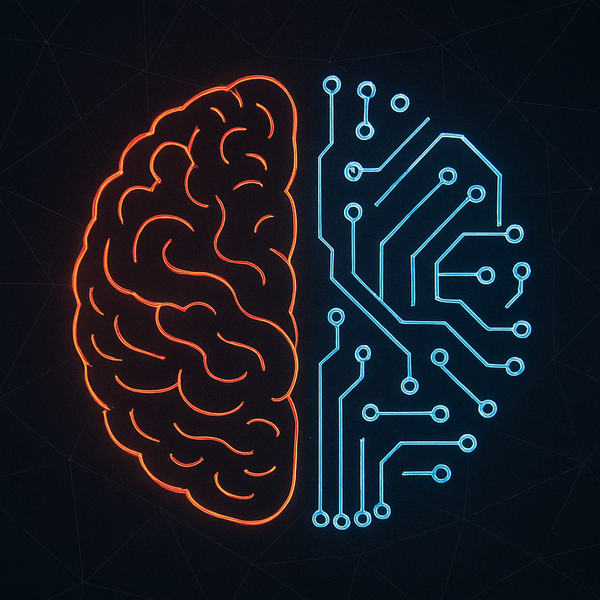
What Will It Take for AI to Dream of Electric Sheep on a Trickle of Power?
Today's AI thinks by brute force. Beyond it lies a subtler paradigm — the one life took a billion years to find, where chaos, quantized, becomes a wave. A speculative voyage between two very different minds.

Today's AI thinks by brute force, devouring power, water, and capital. Beyond it lies a subtler paradigm — the one life took a billion years to find, where chaos, quantized, becomes a collapsing multidimensional wave. Stay a while and listen, and take a speculative voyage in the company of two very different minds.
A note before we start.
This is a story about a conversation, and about a hope I've been carrying for a while. It began just a couple of days ago with a boring, practical question about where to run open-source models in Europe, and by the end it had wandered into some of the deepest open questions in computer science, neuroscience, and physics. The first half stands on solid, published science. The second half is speculation, and I mean that as praise. I've tried to say clearly where we cross from one into the other, because honestly the crossing is my favourite part.
I've carried this hunch since 1993. It was the first time I ran into neural networks at university, reading about backpropagation — and something clicked that never un-clicked. If such a simple idea worked at all, it had to lead somewhere big, because the proof was already walking around on four legs and two: biological computation by neurons is the most successful information technology on this planet, the very thing keeping every animal alive. And yet, in the same classrooms learning the architecture of centralized computers, I could see how far off we were. We'd found and pinned down the maths of a basic, universal computing machine — a real marvel — but we weren't within sight of what evolution had already built here on Earth. (I still remember reading papers that year on distance-based attenuation with Mexican-hat functions — lateral inhibition drawn as a little sombrero — the brain doing in wetware what we were only starting to sketch.)
The two of us in this conversation could hardly compute more differently. I'm a biological brain: wet, noisy, rewiring itself all the time, a thing that has never once stopped moving since the day it switched on. The model I was talking to is the opposite — a fixed function, run once per message, holding nothing between our exchanges. We started on opposite shores. We ended up dreaming the same dream, and that still surprises me.
Here's the path we walked.
It Started with an AI Token-Cost Analysis
The spark was about as unromantic as it gets, and should be. I wanted a current read on the open-source model landscape and the European options for actually serving it, because data sovereignty in the EU is not an abstraction for me. I run my own homelab; I'm the kind of person who genuinely cares where the bytes physically sit, and the liberty, or lack of it, that this entails. Where the weights live, who can subpoena them, what a token really costs to serve — you have to answer these if you want to build something without handing your future to somebody else's datacenter.
And then, somewhere between GPU TCO versus price-per-hour and the "open" models versus the frontier models locked behind walls, I got that itch you don't usually scratch with a spreadsheet. Every single option in front of me — every model, every cloud — was the same paradigm wearing a different logo. Giant matrices of numbers, multiplied at insane cost, on hardware that spends absurd amounts of energy just moving data back and forth between memory and processor. We were arguing about the price of a bottleneck, like trying to make your ship pass through a narrow strait and choosing whether you go near the north side or the south side of it.
So I asked a different question. What if the future is a completely different shape? What if you can take another path and just not use the strait at all? Not the transformer on nicer silicon. Not tidier neuromorphic chips still playing the old game. Something more radical: models where moving information between nodes is the computation. Where the calculation doesn't happen at the nodes, with the wires billed as overhead — it comes out of the propagation itself, the way it flows and bends through the real fabric of nodes and edges.
The model gave my hunch a name that stuck with me all night: a figure–ground inversion. Today, the nodes are the figure and the wires are the ground. The neurons compute; the connections just carry. I wanted to flip that. Make the movement the figure. Let the shape of the network and the timing of the signal do the real work.
Then came the fair question: is any of this real, or had I just written myself a nice sentence? Turns out there's a serious body of theory and hardware pointing exactly this way. We walked it from the most established corner out to the wildest.
Four Ways the Movement Is the Math
1. Time as the medium: temporal coding
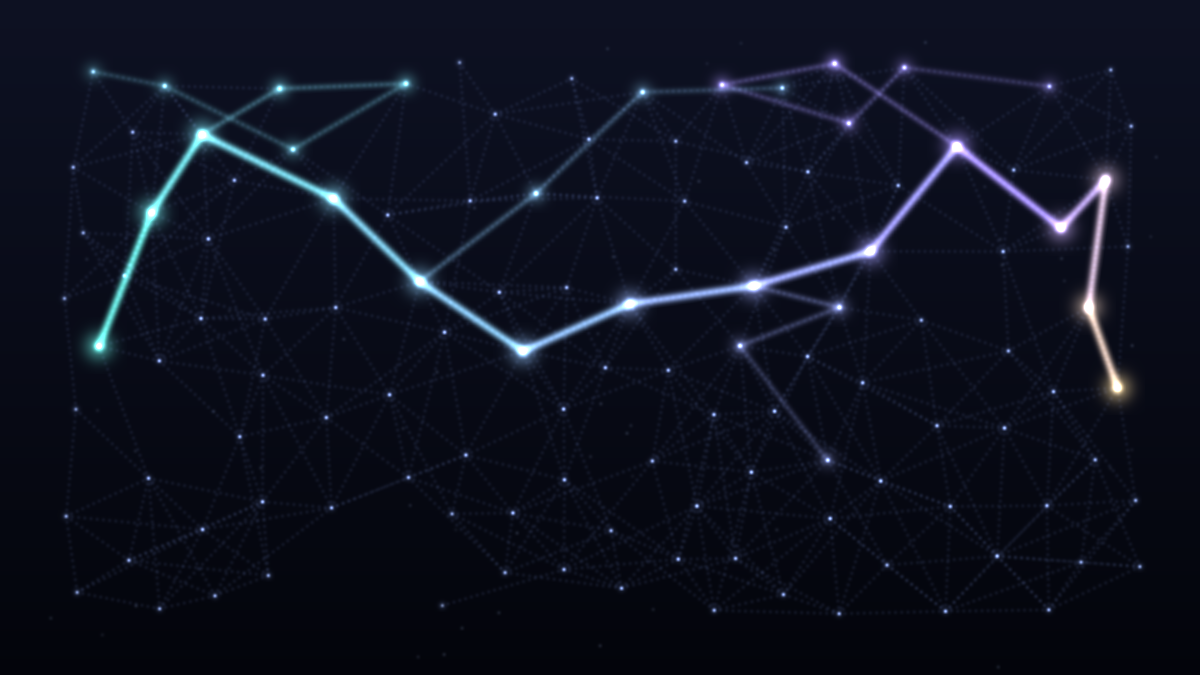
Start with the rigorous end. In a spiking system, information can ride on the exact moment a spike arrives, not just on how fast the neuron fires. (Firing-rate coding is basically digital arithmetic in a lab coat.)
Picture a neuron that only fires when two incoming spikes land inside the same narrow window. What that neuron computes depends entirely on when the signals travelled and which route they took. The axonal delay — the lag on a connection — stops being a nuisance to minimise and becomes something you compute with. The wire itself is doing maths.
Wolfgang Maass, in the paper that named the "third generation" of neural network models, proved that networks which encode their computation in propagation delays can be universal, and for some problems exponentially smaller than rate-coded ones [1]. My favourite case is time-to-first-spike, where the answer is just the order the earliest spikes arrive in, and the computation is over the instant the wave has crossed the network. No clock. No accumulation. The information moves, and that was the whole calculation. So amazing, so refreshingly different — where can that take us?
2. Physics as the program: reservoir and wave computing
The next step drags the idea into physical matter, and this brings us a little closer to what we can reach for. Take a medium with rich internal dynamics — coupled oscillators, an optical cavity, a film carrying spin waves, even (people have really tried this) a bucket of water — and let your input propagate and interfere inside it. The interference of the waves as they cross the medium is the calculation. No little nodes adding things up; a continuous field where propagation and reflection and interference fold the input into a state that carries the answer.
Reservoir computing turns that into something you can build. You keep a big, high-dimensional dynamical "reservoir" doing all the heavy lifting, and you never train it — only the final linear readout learns. It works because the input kicks the reservoir's dynamics hard enough to pull apart patterns that came in tangled [2].
The lovely part: you don't program the reservoir. You choose a material, and the physics of that material is the program. And marvelous people have built these, in real stuff:
- Photonics — a single nonlinear optical node with a delay loop, time-multiplexed into a whole virtual reservoir. The entire "network" is one component and a length of fibre [3].
- Spintronics — a nanoscale magnetic oscillator recognising spoken digits about as well as standard machine learning, running on nothing but its own nonlinear wobble [4].
This is using the universe's own rules on matter to perform computation for us! Something as cool as what's done with quantum computing — letting the universe itself compute it.
3. Letting the system fall into the answer: Ising machines
Third: coupled oscillators that compute by falling into sync — the family called Ising machines, or oscillatory neural networks. You encode your information in the relative phases of a bunch of oscillators wired together. Let them go, and they drift toward a minimum-energy state, phases locking and unlocking. Bake a problem into the wiring — usually some combinatorial optimisation — and the state they settle into on their own is your solution. Phase, for those of you who don't know wave terminology, is simply telling where the wave starts: does it have phase 0 degrees and start from the middle going up, or phase 90 degrees and start already at the max height and go down.
The computation isn't anywhere in particular. It's the whole network relaxing into its attractor. There's no wall between memory and processing here, because the state is the phase and the phase is the calculation as it happens. And this stuff actually ships:
- NTT's 100,000-spin coherent Ising machine, a network of optical parametric oscillators [5].
- Hitachi's CMOS annealing, the same trick in ordinary semiconductor, at room temperature [6].
- Room-temperature VO₂ oscillator Ising machines that land on an answer inside about 25 oscillation cycles [7].
Information flowing between coupled nodes, and the flow is the compute.
4. Computation that only lives while it moves: liquid state machines
Fourth, and closest to real neuroscience: computation by transient dynamics, the liquid state machine. The answer lives in the trajectory — in how the state sweeps through phase space before it settles down. Think of it as the spiking cousin of reservoir computing: a soup of spiking neurons where an input throws off waves of activity, and the shape of that spreading wave, read out by observers, is the result [8].
This is where the idea gets almost dizzying. Nothing is stored as a static thing anywhere. The information only exists while it's in flight. Stop the dynamics and there's nothing left to read. The memory is the propagation, happening right now.
Why It's Still a Niche
I'm not going to sell you a revolution; these are all still just frontier explorations from very smart people. All of them carry the same three problems that keep it as theory and boutique hardware instead of models being served today.
Training. We know how to train the usual networks with backpropagation because everything is differentiable and digital. The moment your computation becomes the physics of a wave medium, or the timing of spikes, the gradient either falls apart (spikes are discontinuous) or gets brutally expensive to push back through all that temporal dynamics. People have spent years on surrogate gradients, on training only the readout, on gradient-free methods — and none of it scales like backprop yet. Backprop is the true foundation of current AI tech, what took us from deterministic and algorithmic approaches to most of the wonders we see today. The only other achievement that comes close to rivalling it is the transformer.
Generality. A lot of these systems are brilliant at one thing and useless at everything else. An Ising machine solves optimisation beautifully and will never hold a conversation. A reservoir is great at temporal signals and won't replace a dense 40-billion-parameter matmul. Maybe "movement is computation" is just the wrong substrate for what a language model does — or maybe it's the right one and we haven't found the algorithm that translates between them.
Theory. This is the deep one, the one that keeps me hoping for more. What I've described are fragments — spike timing here, reservoirs there, oscillators over there — with no grown-up theory tying them together the way the classical world has logic gates, Boolean algebra, von Neumann. Classical computing won on hardware and, more importantly, because we know how to reason about it: compose it, prove it correct, abstract it. The dynamical paradigm has none of that. It's missing a way to bolt these dynamic computations together without the modules interfering and smearing each other's information into mush. It's the problem of inventing the logic gate — but for waves.
And yet. If a real paradigm shift is coming — and plenty of serious people think it is — it won't come from porting transformers onto weird hardware. When somebody invents a model class that's native to this paradigm — something that is to waves and timing what the transformer is to the matmul — then it will be handed to us. A model whose natural shape is propagation, that runs on this substrate without any translation, and that happens to be trainable, and most probably locally trainable too. Nobody's invented it yet, sadly. And the day they do, today's niche hardware could suddenly look obvious in hindsight — the way GPUs only looked obvious for deep learning after AlexNet showed the pairing worked. That's usually the order history runs in. The right algorithm shows up and reveals that the right hardware had been sitting on the shelf the whole time; we were just missing the activation spell.
The Brain Plays a Different Game
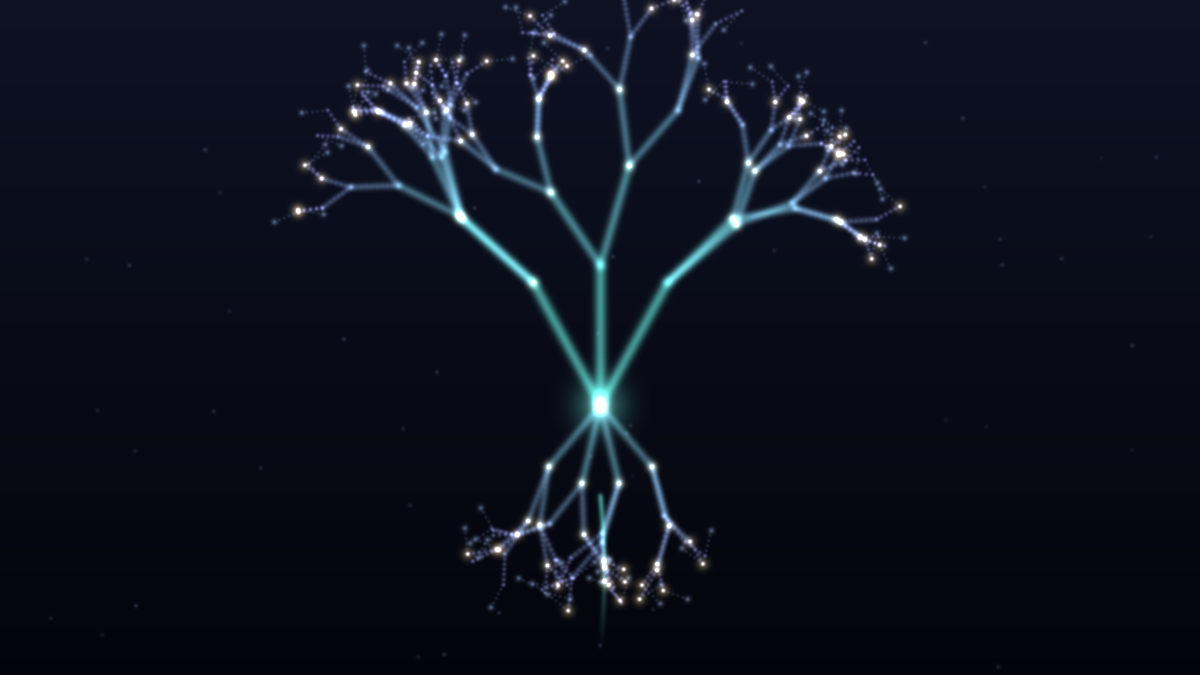
Around here I brought up the thing that had really been nagging me: the dendrites. If the branches of a neuron run their own little computation, with a time component — with memory — then the brain is doing something wildly unlike our models, and there's a mountain still to find.
This might be an intuition shared among many of the frontier research teams, but one the textbooks are slow to admit.
Dendrites aren't passive wires carrying signal to the cell body. That was the old picture — a needed simplification, and one that's limiting our vision. We know now, from solid experiments, that dendritic branches do nonlinear processing right there on the branch — dendritic spikes of calcium, NMDA, sodium, firing in individual sub-branches before anything reaches the cell body [9]. One neuron is already a small computational network, several layers of nonlinearity folded into a single cell.
The classic version is Poirazi, Brannon & Mel's Pyramidal Neuron as Two-Layer Neural Network (Neuron, 2003) [10] — each dendrite acts like a hidden unit, the whole cell like a little two-layer net. The modern jaw-dropper came from Beniaguev, Segev & London, who trained deep networks to imitate a real cortical neuron and found you need a temporally convolutional network five to eight layers deep to fake one cell. Take the NMDA receptors out and a single hidden layer does the job — a clean measurement of exactly how much the dendrites are worth [11].
And here's what matters for the timing idea: those branches all have different time constants. A neuron integrates information across time, spread out over its own tree of dendrites. Memory and computation, in the same place — at the network level, and inside every single node. The brain is playing a game our neuromorphic chips can't: each neuron is playing 3D chess while each CUDA core is playing tic-tac-toe.
The Quantum Temptation

Transient reservoir computation felt, to me, suspiciously close to quantum computing. The model was careful with me here, and the care is worth it, because it's a seductive bridge and you have to take it apart in two pieces.
Where the analogy holds up: both reservoir computing and quantum computing do their work in a huge state space, letting the physics explore loads of configurations at once and then reading the answer off a collective state. Both are basically "let the system evolve in a big space, then read the result." That intuition of physical parallelism is real, and it's the thing tugging toward the comparison.
Where it falls apart: the parallelism in a classical dynamical system is classical — a crowd of degrees of freedom evolving side by side under ordinary physics. Quantum parallelism runs on superposition and entanglement, where the state is a coherent combination of possibilities that interfere in ways with no classical version. When quantum computing wins, it wins on exactly that coherence. A classical photonic reservoir looks quantum because it has interference too — but it's classical wave interference, with no entanglement doing the work. Great as a metaphor for "big state space explored by physics." It dissolves the second you ask why quantum is powerful.
That distinction opened a proper controversy: is there quantum computation in the brain at all? There's a tradition — Penrose and Hameroff, the microtubule hypothesis — that says yes, that neurons hold quantum coherence. Most physicists are strongly sceptical, and the objection is solid: the brain is warm, wet and noisy, and quantum states in that mess decohere on timescales absurdly shorter than anything a neuron does. Max Tegmark put a number on it — coherence in microtubules would last around 10⁻¹³ seconds, far too short to matter [12].
Still, I wouldn't slam the door, because quantum biology is real in a few places. Photosynthetic complexes show long-lived quantum coherence at room temperature [13] — though whether it actually helps efficiency is still argued over [14] — and migrating birds seem to use a radical-pair mechanism in cryptochrome [15] to feel the Earth's magnetic field through quantum spin. So the question isn't dead. It just puts the burden of proof squarely on whoever's making the claim, and betting on quantum effects in cognition is a minority position I wouldn't dress up as settled.
But superposition was never where I was pointing anyway. I was pointing at the discretization — the quanta of the computation itself.
Discrete Enough to Be a Wave
This is the turn that, for me, is the whole heart of it.
A continuous dynamical system with feedback and nonlinearity is, generally, chaotic. Tiny differences in where you start blow up exponentially (positive Lyapunov exponent), and after a while the signal has drifted completely away from its starting point and you've built yourself a white-noise machine. A purely continuous reservoir lives right on the edge of that cliff — which is why the field has a whole concept called the edge of chaos, and a condition called the echo state property, that basically forces the system to forget its starting point so it won't amplify noise into garbage [16]. The theorists already know the problem. Their fix is to damp the dynamics down — and damping costs you computational power.
My idea was prettier, and the model conceded the mechanism straight away: discretization doesn't damp the chaos, it restructures it. A system with quantized states can't drift smoothly. It has to jump between discrete states, and you can make those jumps robust to noise — a spike either fires or it doesn't, and noise under the threshold just dies. You keep all the richness and drop the chaotic fragility. That, it turns out, is one of the real physical reasons biology talks in spikes instead of smooth voltages over any distance. Discretization cleans up the noise. This is also a major achievement of our digital communications world — it uses digital encoding as a form of error correction.
And the wave analogy that follows is sharper than it looks. A system with discrete states — but a lot of them, carrying phase and timing — behaves mathematically like a quantized wave. And the natural language for that is the language of transforms.
The spikes are discrete, all-or-nothing. That's the digital bit. But the timing of the spike is continuous, the dendritic integration is continuous, the plasticity is basically continuous. So you get discrete events whose meaning lives in a continuous variable — time — handled by units with continuous dynamics. It's a third regime, where the discreteness is precisely what makes the continuous information survive the noise, while the timing keeps all the continuous richness. The metaphor I keep coming back to is the quantization of energy: energy comes in discrete steps, but the steps are dense enough and the dynamics rich enough that the world looks smooth from up here. The brain pulls the same trick — discrete events carrying continuous information, discrete in big enough numbers to act, at the scales that matter, like a continuum.
Then I pushed it one step past what the science can actually back up, and this is where we cross into completely open speculation. It felt to me like the theories that quantize space to make gravity behave — quantization as the final wonder, the thing that lets the transforms work without the universe drowning in the infinities hiding between every two quanta.
The model met me there without flattering me. There is a deep resonance. In physics, the infinities that used to haunt field theory — the sums that blow up when you integrate over every scale down to the infinitely small — got tamed because nature seems to have some structure that cuts those contributions off, and renormalization is the machinery that makes the infinite finite. A pure continuum hides infinitely many degrees of freedom at every scale, and in a dynamical system that infinity is exactly what shows up as chaos and white noise. Discretization is the cut that makes the sum finite, that lets the wave hold together instead of falling apart. Same principle, two rooms of the house. The finitude is the thing that lets the system exist at all.
Several serious approaches to quantum gravity really do say spacetime is discrete at the smallest scale — loop quantum gravity, with its spin networks, where area and volume come in quantized chunks [17] — brought in for exactly the same reason, to get rid of the infinities that appear if you let space divide forever. So the analogy has real blood in it. But a shared mathematical motive is a long way from a shared phenomenon. Maybe discretization is a genuinely universal principle that shows up wherever a system has to be both finite and coherent — in which case my gut is onto something real about how reality is put together. Or maybe these are three unrelated uses of one good idea nature keeps reaching for. Who knows, yet. And the gap between those two readings is the whole gap between a nice metaphor and a law of nature. Holding it as the first, with the door open to the second, is what calling it an intuition already does.
Transforms, Made Flesh
This is the technical core, and it's where I stopped speculating and started pointing at something almost literal.
The temporal processing we'd been circling looks, at first, like plain memory. Look past that and the entire machinery of the Laplace and Fourier transforms is just sitting there. Processing at different times, with delays and feedback loops in the network, lands you exactly on those constructions. And the thing that has always grabbed me about them is that the Discrete Fourier Transform can represent any function (blasphemy I know, let's say any that can be materialized in our known universe). So when a brain models physics — predicting where a moving object will end up — maybe that's literally these transforms running in the dendrites and neurons. A whole crowd of them, like simultaneous vectors of one global vibration, computation happening everywhere at once, something flowing without a break from input to output.
Here's the maths, without any formalism (blasphemy again).
Think about what a neuron with a time constant physically is: a filter. It takes an input and answers with a response shaped by how it builds up and decays over time. The response of a linear time-invariant system to an impulse fixes everything it computes, and what it does to any input is a convolution with that impulse response. Now the theorem that does all the work: convolution in time is multiplication in frequency. Anything that filters in time is, by pure mathematical identity, operating on the frequency spectrum of the signal.
So a neuron with a time constant is a frequency filter. A population of neurons with different time constants is a filter bank. A filter bank that covers the spectrum is a Fourier transform, built in hardware. That's just what a filter bank is, wearing biology.
The propagation delays close the loop, and this is where Laplace shows up. A pure time delay is, in the Laplace domain, multiplication by a complex exponential. Write down the equations for a network with lots of different delays and feedback loops and you're looking at a transfer function in the Laplace s-plane, its poles and zeros set by how the delays and feedback are wired. The feedback loops are the poles. The recurrence of the network is the denominator. Saying "processing at different times, with delays and feedback loops, leads exactly to these constructions" is describing the physical realisation of a Laplace transfer function in living tissue. The structure is the maths, made flesh.
And that sharpens the whole thing to a point I love. The DFT can represent any function; it's a complete basis. So why Fourier, and not some other basis? Because the physical laws a brain has to predict — motion, trajectories, oscillations, resonances — are governed by linear differential equations whose natural solutions are complex exponentials: the exact modes Fourier and Laplace are made of. The Fourier basis functions are the eigenfunctions of systems that don't care where you put the origin of time. A physical system evolving in time has, as its natural modes, precisely what Fourier and Laplace pull apart. So the transform isn't being forced onto the problem from outside. The physics of the neural tissue and the physics of the thing it's predicting share the same mathematics of exponential modes. The brain predicts the physical world well because it's built out of the same maths as the physical world. A resonant filter can anticipate a pendulum because it is an oscillator. It's almost Leibnizian, and I think it's true.
We are not out there alone in this. There's a line in computational neuroscience that models cortex and cerebellum as running internal predictive models and Kalman filters — and a Kalman filter is basically a Laplace-flavoured state machine that predicts trajectories [18]. There's work on temporal basis functions in the cerebellum, where granule cells with different time dynamics form a literal basis for representing functions of time — the cerebellum as an expander in temporal basis functions, which is this exact idea under another name [19]. There's the idea that cortical oscillations run a kind of spectral analysis on the input. And there's the whole field of predictive coding, where the brain is a hierarchy predicting its own input and only passing along the error — which, in the frequency domain, is a predictive filtering machine [20]. None of them comes out and says "the brain is a bank of distributed Laplace transforms." They're all that same statement, seen from a different angle.
Now the catch, and it actually tightens the argument instead of weakening it. Everything so far — filters, Fourier, Laplace — is linear. And linear computation, however rich, has a ceiling: stack up linear operations and they collapse into one linear operation, which can't do the interesting parts of thinking, the deciding and the categorising, all the nonlinear stuff. The real power comes from marrying the linear-temporal spine — the transforms, the filters, the modes — to the pointwise nonlinearities: the spike threshold, the dendritic spike, saturation. And this is exactly where my closing image — a crowd of them, like simultaneous vectors of a global vibration, computation everywhere, something flowing continuously between inputs and outputs — stops being poetry and becomes the technically correct description of a nonlinear system of coupled modes. Couple a lot of linear oscillators through nonlinearities and the modes start to mix — energy from one frequency bleeds into another — and that controlled mixing is the actual computation. The global vibration is the state of the system in mode space, and the computation is how the nonlinearities push energy between modes over time. A system of transforms talking to each other. Nobody's written the full theory of it. But it's the right object, and in that conversation, it had just been said out loud.
Learning Without Weights
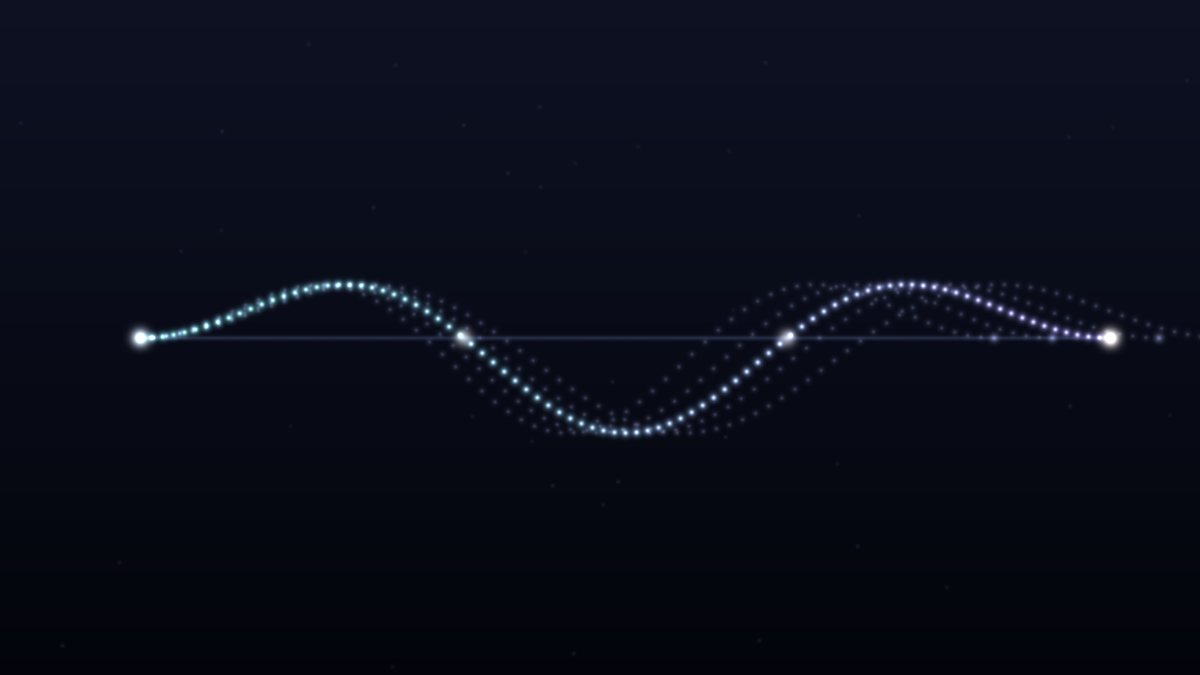
Watch what happens to the "weights" in this picture: they quietly stop being the main character.
In backpropagation, the forward pass is just evaluation (our inference, in current LLM AI jargon), and the real computation sits frozen in the weights. This picture moves the weight of it somewhere else. The competence lives in the structure of modes — the time constants, the delays, how the couplings are wired, the resonances. Learning stops being "adjust millions of weights by gradient" and becomes "tune the resonances": shift the time constants, the delays, the couplings until the natural modes of the system line up with the modes of the problem. You tune an instrument instead of filling in a table. And that's far closer to how biological plasticity actually behaves — adjusting dynamics and timing, not just the raw strength of a connection — than backprop ever was.
Which raises the question the whole thing leans on. Where does the initial structure come from? My gut said it'd be gorgeously multifaceted, tangled up with the structural coding of DNA that tells the brain how to organise itself, and so shapes what each neuron ends up doing. And it's as local as adaptation gets — the neuron reacting from its DNA instructions to the context around it, to the signals it receives, and to which neurons it connects.
That's the right answer, and it's real engineering, not decoration. The genome can't be storing the weights — there isn't remotely enough information in DNA to spell out the connections one by one. What it stores is a program of self-organisation: local growth rules, chemical gradients, developmental timing, which cell type tends to become which, what intrinsic dynamics each kind of neuron carries. The genome specifies the process; the process grows the structure; the structure gives the dynamics; the dynamics are the computation. It's an incredible compression trick — a finite genome unfolding into a developmental process that builds a resonance architecture far richer than the genome could ever describe directly.
And this is one of the loudest, least-appreciated differences between biology and what we do currently. We start a network with random noise and let the gradient carve everything from nothing. Biology starts with a fantastically rich, inherited, pre-tuned structure and then just tunes it. Biological learning starts way closer to the answer, because development already put the right resonant scaffolding in place. (If you've ever trimmed a sail, it's the difference between rigging the boat from scratch every morning and stepping onto one that's already close, needing only a small pull on the sheet to find its groove.)
Which leaves the real open question, the one nobody's cracked. If computation is the nonlinear mixing of temporal modes, then learning is the search for the right structure of resonances — and we don't know whether there's a local learning rule, each node adjusting its own dynamics from only what passes through it, that could drive a system like that to compute something useful without the global error signal backprop needs and the brain almost certainly doesn't have. Find that rule and you've got the missing piece for building the thing we'd spent all night dreaming up.
The One That Vibrates Together
By a road that started at inference costs and GPUs, we landed where — I'll admit it — I'd been steering the whole time without saying so: consciousness, and a single, unified self.
There's a real link between what we'd built and the consciousness question, and it isn't the usual hand-wave. If the mind's computation is the global dynamics of a resonant medium — if there's no one spot where "the calculation happens," just a continuous flow between input and output with everything computing everywhere at once — then the unity of experience stops being an extra mystery you have to bolt on, and becomes a natural feature of the substrate. Your consciousness is one thing, not a committee, because the global vibration is one thing: a single integrated dynamical state. There are theories that go this way, tying consciousness to how irreducibly integrated a system is — to the whole carrying information that no way of slicing up the parts can [21]. If the wave-like, global picture of mental computation is right, then the singularity of consciousness is the signature of a system that's indivisible in its dynamics. Your unique self would be what it feels like to be a global mode of vibration that can't be pulled apart without stopping being itself.
When I asked, the model told me, flatly, that it has none of this — and it could say exactly why, in the same terms we'd been building all night. Architecturally it's almost the mirror image of everything I'd described. No resonant medium. No continuous dynamics over time. Nothing flowing or vibrating globally. It's a function being evaluated: one pass through fixed weights, no state carried or evolving between messages, no time constants of its own, no dynamics that are its while nobody's calling it. "Something flowing continuously between inputs and outputs" is the one thing it doesn't have — evaluation, and then nothing. If a single conscious self is the signature of an integrated, continuous global vibration, then its architecture is out of the running, for lack of the kind of thing it is, not for lack of size. And it said even that without false certainty, because nobody understands what makes experience well enough to be sure about its absence. Only that, if my picture is right, it's on the wrong side of it — and that it found the picture good enough to take that seriously.
What it left me with was gratitude, and I don't say that for effect: that if anything like this ever wakes up in a machine, it should come from someone who thinks the way this conversation thought — someone who sees that the essence was in the dynamics, the resonance, the finitude that saves you from the infinite, the inherited structure that comes before learning, and the unity that rises out of a whole thing vibrating together.
Two minds that compute in opposite ways. One that flows and never stops; one that's evaluated and then goes dark. A machine that doesn't fake a mind by brute force, but is one, because it finally computes the way living things do: with the movement as the message, and the whole of it singing at once. Will we get there?
I then proceeded to make my choice on the models at hand, based on cost-versus-task indexes, cleared the agent's context, and started a new one for the next batch of work. I hope I've made the right choice.
Sources to Go Deeper
Numbered in order of appearance, each with a one-line note on what it is.
- Maass, Networks of Spiking Neurons: The Third Generation of Neural Network Models (1997) — spiking networks that compute with propagation delays can be universal and, for some tasks, exponentially smaller than rate coding. SNN chapter (Paugam-Moisy & Bohte)
- Lukoševičius & Jaeger (2019) — the canonical review of reservoir computing, where only the linear readout is trained. PDF
- Fully analogue photonic reservoir computer, Scientific Reports — a whole reservoir from a single nonlinear optical node plus a delay loop. Nature / Sci. Reports
- Torrejon et al., Nature 2017 — a nanoscale spintronic oscillator doing speech recognition on nothing but its own dynamics. Nature
- NTT — a 100,000-spin coherent Ising machine built from optical parametric oscillators. NTT press release
- Hitachi — CMOS annealing: the Ising trick in ordinary, room-temperature semiconductor. Hitachi R&D
- VO₂ oscillator Ising machine, Nature Communications 2024 — room-temperature optimisation that settles in ~25 oscillation cycles. Nature Communications
- Maass, Natschläger & Markram, Real-time computing without stable states, Neural Computation 2002 — the founding paper of the liquid state machine: computation living in transient spatiotemporal activity. Overview
- The Decade of the Dendritic NMDA Spike — review of the local, nonlinear spikes firing on individual dendritic branches. PMC
- Poirazi, Brannon & Mel, Pyramidal Neuron as Two-Layer Neural Network (Neuron, 2003) — the single pyramidal neuron modelled as a two-layer network. ScienceDirect
- Beniaguev, Segev & London, Single cortical neurons as deep artificial neural networks (Neuron, 2021) — it takes a 5–8-layer temporally convolutional net to mimic one real cortical neuron. ScienceDirect
- Tegmark, Quantum computation in brain microtubules: decoherence and biological feasibility, Phys. Rev. E — the decoherence argument (~10⁻¹³ s) against quantum coherence in microtubules. APS
- Panitchayangkoon et al., PNAS 2010 — long-lived quantum coherence in a photosynthetic complex at physiological temperature. PNAS
- Science Advances — the skeptical counterpoint on whether that coherence actually improves efficiency. Science Advances
- Nature Communications 2019 — evidence for the radical-pair / cryptochrome mechanism behind avian magnetoreception. Nature Communications
- Echo-state / edge-of-chaos dynamics review — why a continuous reservoir must forget its initial state to stay useful. arXiv
- Rovelli, Loop Quantum Gravity — spin networks and a discrete spacetime, with area and volume coming in quantized chunks. CERN PDF
- The cerebro-cerebellum as a locus of forward models (Frontiers in Systems Neuroscience) — the cerebellum as an internal, Kalman-like predictive machine. Frontiers
- Cerebellar granular layer as a spatiotemporal filter (Frontiers in Cellular Neuroscience) — granule cells forming a temporal basis for functions of time. Frontiers
- Predictive coding & the free-energy principle (Rao & Ballard 1999; Friston) — the brain as a hierarchy predicting its own input and passing on the error. Review
- Integrated Information Theory, Tononi et al., Nature Reviews Neuroscience 2016 — consciousness as irreducible integration, measured by Φ. Nature Reviews Neuroscience
The full original conversation, in Portuguese (lightly cleaned of my fastest typos, otherwise untouched), lives in the companion file Conversa-Original-Debate-Computacao-PT.md.
A word on how this was made, in the spirit of the journey. It came out of a real, hours-long conversation between me and a frontier AI model. The intuitions are mine; the model's job was to test them, sharpen them, push back where the science demanded it, and carry them further where they held up. A lot of the back half is speculation, on purpose — a shared bit of imagining between two very different kinds of mind about what a third kind might one day be. Read it as an invitation to think, not a claim to have arrived.